
Why this matters
Itching can make even a simple shower feel like a series of guesses: wash more, wash less, change products, or stop everything. This post is for deciding what to do next without assuming that buying a cleanser is automatically the answer.
You will get a simple external-care routine, the main reasons to keep it minimal, and a clear way to compare water alone with a Jolaine cleanser. The guidance also separates soothing a symptom from establishing its cause.
Jolaine’s itch-relief intimate cleanser is a vegan 150 ml wash developed and made in Quebec and presented for soothing intimate itching. It is a cleansing product, not an established way to diagnose or treat the cause of that itching.
What Soulage les démangeaisons is: Jolaine’s vegan, cruelty-free Soulage les démangeaisons intimate cleanser, a 150 ml product developed and manufactured in Quebec and presented by the shop for soothing intimate itching.
What it is not: It is not established to diagnose or treat the cause of itching, cure an infection, or replace assessment by a doctor or pharmacist. No supplied evidence compares it with a medical treatment.
The short answer
An intimate wash for sensitive skin is optional, not a requirement: if mild irritation occurs, clear water is adequate. If you prefer soap, the American College of Obstetricians and Gynecologists advises plain, unscented soap on the vulva, followed by a cool or lukewarm rinse and a gentle pat dry. American College of Obstetricians and Gynecologists
That answer applies to the vulva, the external skin. The vagina is self-cleaning, and Kent Community Health NHS Foundation Trust says over-washing may increase irritation; it generally advises washing the vulva once daily with water or an emollient. More foam, more repetitions, and more products are not automatically better. Kent Community Health NHS Foundation Trust
So the practical choice is this: try the least complicated routine that is comfortable for you. A cleanser can be a preference, not a prerequisite, and soothing a symptom is different from working out why it started.
Intimate wash for sensitive skin: what it depends on
Start with what is already touching the area. Ashford and St Peter’s Hospitals lists soap, shower gel, cleansing wipes, perfumes, deodorants, and antiseptics as possible irritants for vulval skin. It also recommends washing gently with your hands instead of a cloth, so changing the method may matter as much as changing the bottle. Ashford and St Peter’s Hospitals NHS Foundation Trust
Location matters too. ACOG advises avoiding lotions and perfumed products on the inner vulva. That is a reason to keep the routine external and restrained, rather than layering several leave-on products over skin that already feels reactive. American College of Obstetricians and Gynecologists
If you are comparing Jolaine formulas, the shop publishes sensitive-skin ingredient information separately. Use it to check what is in a product and whether you want it in your routine, not as proof that an ingredient will resolve your symptoms.
A gentle routine you can actually follow
Keep the frequency modest: the NHS guidance cited above generally supports once-daily washing of the vulva with water or an emollient. Washing inside the vagina is not the goal, because it cleans itself. If you have been washing repeatedly to chase away itching, simplifying is a reasonable step to discuss with a pharmacist or doctor. Kent Community Health NHS Foundation Trust
When you wash, use cool or lukewarm water and rinse well. If you use soap, ACOG’s guidance is for a plain, unscented one; afterwards, pat the area dry gently rather than rubbing. Stop if the routine seems to make your irritation worse. American College of Obstetricians and Gynecologists
Do not scrub with a flannel or brush. Kent Community Health NHS Foundation Trust specifically advises against that because the vulval area should be washed gently. Use a light touch; there is no need to scour sensitive skin to feel clean. Kent Community Health NHS Foundation Trust
If you choose a Jolaine cleanser, follow its label and the shop’s instructions for use rather than assuming that a larger amount will soothe more. The product directions and your skin’s response should guide the routine, and persistent symptoms still deserve proper advice.
Where Jolaine fits—and where it does not
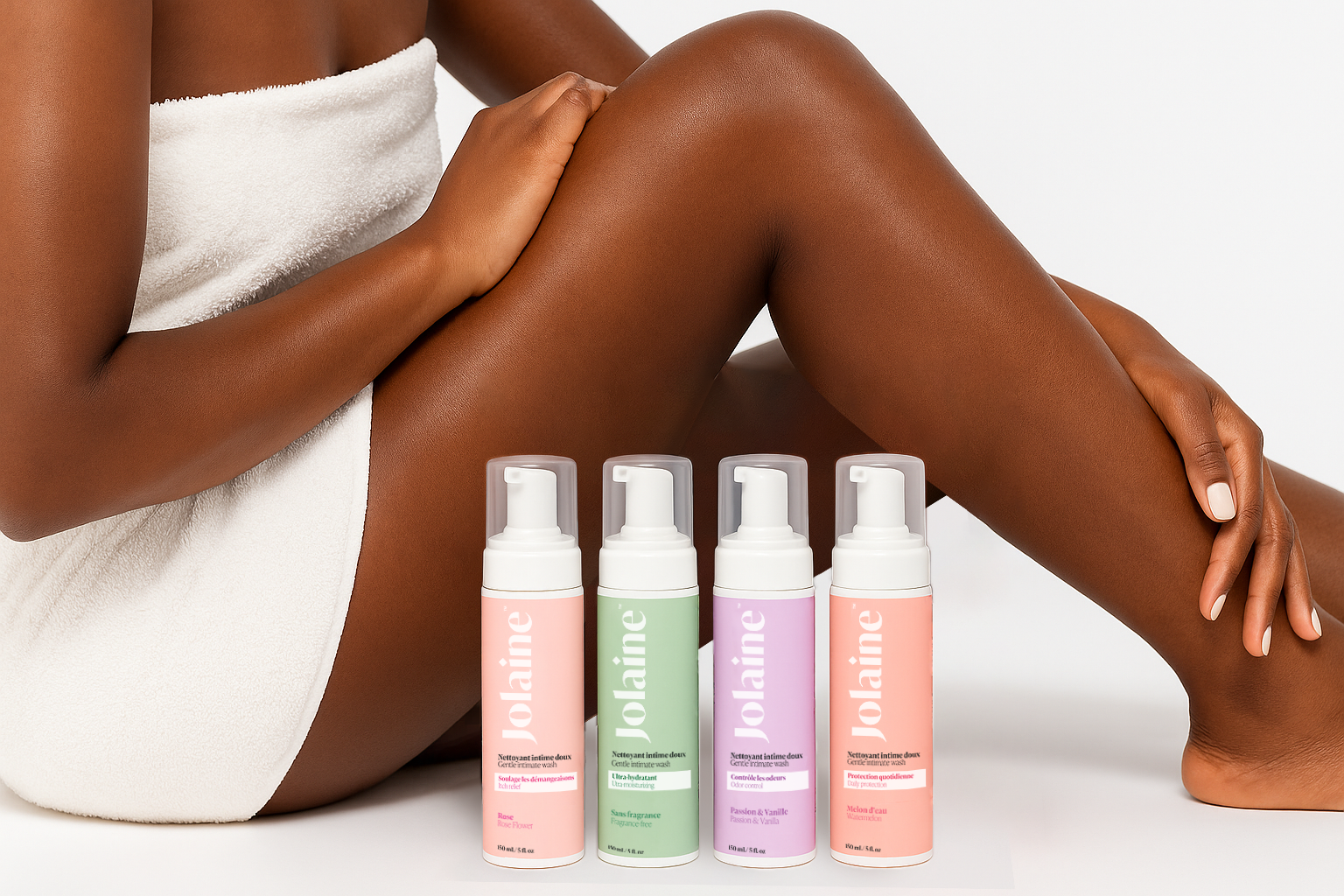
For a shopper whose main concern is itching, Jolaine’s Soulage les démangeaisons cleanser is the most directly named match in its range. The shop describes it as a fresh intimate cleanser in a 150 ml size, and the brand says its products are vegan, cruelty-free, dermatologically tested and made in Quebec. Those are product and manufacturing facts, not evidence that it treats an underlying condition.
If hydration is your priority instead, the Ultra-hydratant intimate cleansing foam is the shop’s 150 ml option for sensitive skin. It is not automatically better for itching: it simply matches a different stated need. Choose between them by the job you want the cleanser to do, and leave the anti-odor cleanser out if odor control is not your concern.
If avoiding added scent is central to your choice, you can also browse Jolaine’s unscented intimate wash collection. That collection label helps you narrow the shop’s range, but it does not tell you whether a particular product will suit your skin or resolve itching.
Do not buy either cleanser on the theory that persistent itching must be a hygiene problem. If symptoms persist, return, are severe, or otherwise worry you, ask a doctor or pharmacist for assessment; a wash cannot provide a diagnosis.
Frequently asked questions
Do I need an intimate wash at all?
Not necessarily. ACOG says clear water is adequate if mild irritation occurs, while its soap guidance is to use a plain, unscented product on the vulva, rinse with cool or lukewarm water, and pat dry. You can choose the simpler option if it keeps you comfortable. American College of Obstetricians and Gynecologists
Can I wash more than once a day if I itch?
More washing is not necessarily helpful: Kent Community Health NHS Foundation Trust says over-washing may increase irritation. It generally recommends washing the vulva once daily with water or an emollient, and notes that the vagina is self-cleaning. Kent Community Health NHS Foundation Trust
Is a washcloth better than using my hands?
No. Ashford and St Peter’s Hospitals recommends washing vulval skin gently with the hands rather than a cloth. If you are currently using a cloth and feeling irritated, changing that technique is a simple step to try. Ashford and St Peter’s Hospitals NHS Foundation Trust
Can I put lotion or a scented product on my inner vulva?
ACOG advises avoiding lotions and perfumed products on the inner vulva. Keep your routine simple, and do not add a leave-on product just to mask what is happening; persistent itching is a reason to seek advice rather than cover it up. American College of Obstetricians and Gynecologists
Will Jolaine’s itch-relief cleanser treat the cause?
That is not established by the information supplied here. The shop presents it as a cleanser that soothes intimate itching, which is different from diagnosing or treating an underlying cause. If itching persists, keeps returning, is severe, or worries you, ask a doctor or pharmacist.
Which Jolaine option fits sensitive skin best?
For itch as the main concern, the Soulage les démangeaisons cleanser is the closer match by stated purpose. If your priority is hydration, the Ultra-hydratant cleansing foam is the shop’s sensitive-skin alternative. Neither choice should be used to postpone assessment of symptoms that concern you.
When should I ask a doctor or pharmacist?
Ask when itching persists, keeps returning, is severe, or comes with anything new that worries you. Also ask before cycling through more products if your routine is not helping. A cleanser cannot tell you what is causing the symptom.
What we make
Soulage les démangeaisons
Its stated purpose is soothing intimate itching, which directly matches this reader’s main concern; it is a 150 ml vegan cleanser made in Quebec, not a substitute for finding the cause.
Ultra-hydratant
The shop positions this 150 ml cleansing foam as ultra-hydrating and for sensitive skin, making it the alternative for readers whose priority is hydration rather than itch relief.
One last thing
Start with the gentlest choice: keep washing external and minimal, and never let a new cleanser delay advice about persistent itching.
Where this comes from
- American College of Obstetricians and Gynecologists — The American College of Obstetricians and Gynecologists says to wash the vulva with plain, fragrance-free soap, rinse with cool or lukewarm water, and gently pat dry; if mild irritation occurs, clear water is adequate.[1]
- Kent Community Health NHS Foundation Trust — Kent Community Health NHS Foundation Trust says the vagina is self-cleaning, over-washing may increase irritation, and the vulva should generally be washed once daily with water or an emollient.[2]
- Ashford and St Peter’s Hospitals NHS Foundation Trust — Ashford and St Peter’s Hospitals says vulval skin can be irritated by soap, shower gel, cleansing wipes, perfumes, deodorants, and antiseptics, and recommends washing gently with the hands rather than a cloth.[4]
- American College of Obstetricians and Gynecologists — The American College of Obstetricians and Gynecologists advises avoiding lotions and perfumed products on the inner vulva.[1]
- Kent Community Health NHS Foundation Trust — Kent Community Health NHS Foundation Trust advises against scrubbing with flannels or brushes because the vulval area should be washed gently.[2]